
Blog

  • The Reason We Should Not Eliminate Handwriting At The School

    In the past, various intelligent technology has been added to the process of learning languages including artificial intelligence (AI).

    Do ever-advancing technologies render pens and pencils obsolete? Can digital tools be integrated with handwriting? What can we do to ensure that handwriting remains useful in a modern society?

    Pen or Keyboard: Thinking Aids

    The handwriting tradition has been long associated with learning and memory. The first keyboard was introduced in 1829. Writing became popular after the debut to the world of typewriters around 1867. The past was when students relied on writing for learning; now students alternate between paper and digital media. Research has proven that the two methods are not playing the same roles in storage information and keeping it in mind, nor in the process of acquiring knowledge.

    The study from 2014 found that students who made notes with handwriting were more likely to respond to research questions. In a 2017 study, students ranging from 20 to 25 years old had the ability to retain handwritten notes longer than students who used a keyboard.

    It also revealed that students who employed AI in the early stages of writing, did not retain the written text when taking test on text-citations compared to students who began writing at the very beginning. Thus, it’s important to strike a balance between printing and creating digitally.

    Digital Archives That Have A Low Level of Vocabulary

    In the 2019 study (before AI was as advanced as it is today) In a study, we examined students who wrote handwritten English paper. The annotations had a lower amount of vocabulary which confirmed the previous pattern.

    The study included graduates of 58, all of them wrote a weekly letter. The study was part of the process to prepare for the analysis that was to be presented at the end. Participants were not permitted to make use of resources, for example, dictionaries or automated correction tools during the creation procedure.

    The purpose of this research was to establish if there exist linguistic distinctions between the various forms of creativity. We focused on the specific aspects of writing (such as sentence structure and syntax) as well as syntax.

    Numerous texts exhibit statistically similar the amount of information and organization. This implies that the writing process does not affect the style of writing employed.

    But, in terms of different lexical varieties, these observations do not seem to be consistent. The level of lexical richness is higher in many handwritten outputs. The handwritten production showed weak lexical features that weren’t found in the handwritten output from the same participant.

    These results could be relevant to English language instruction and the way students are taught to read writing texts.

    Writing On Screens Is An Acquired Skill

    The digital revolution puts the pen in the drawer, a number of nations have examined the effects of technology on the writing abilities of Spain and France, United States and France.

    But, new research shows the need for specific strategies for writing to help students advancement, like making plans or proofreading. While handwritten writing can help develop not-keyboard abilities, the ability to master keyboard is a fundamental but highly sought-after ability.

    Writing problems today mostly stem from the sharing space. This is the reason it’s not prioritised in schools’ curriculums in Europe as well as in the United States or China. What is important to remember is the way in which writing is distinct at three different levels.

    In the beginning, handwriting and typing take place in different spatial environments. The typing process takes place in an unison space. While handwriting takes place on two different areas: on a display and on a keyboard.

    The way that people create text with spatial distinction differs when they are writing, transcribing or revision. Also, understanding and comprehension differs according to the method of production.

    It is crucial to continually emphasize the advantages of handwriting for cognitive purposes both in the classroom and at home to ensure that children as well as knowing about the required formal education for digital writing, can attain the same degree of proficiency in writing on paper as well as screens. For classrooms there is an element of pondering the potential the writing tools can offer. We don’t know the impacts the growing utilization of AI can have on writing, where expertise is in high the market.

  • In With The Keyboard When Talk Is Replaced By Typing

    The Keyboard When Talk Is Replaced By Typing

    After the acquisition by Facebook of the speech recognition firm Wit.ai which includes all four of the players on the post-PC market (Apple, Google, Microsoft and Facebook) are now able to offer an excellent hands-free tool on your gadget.

    What does this mean to how we utilize the data we have? Are we just using voice as a means to communicate to your computer? Or is it nearing the end?

    What Is Your Age?

    The first computer that was simple to use was created in the early 1960s by Engineer Doug Engelbart. The keyboard and its smaller predecessor called the teletype was invented in the late 1900s with the help of Charles Krum’s machine which was linked to video screens and the latter was the source of a gadget developed in the 1930s.

    In spite of their aging, these computers remain an integral part of your personal computer either on your desk, or laptop.

    There are certainly greater keys, a wider range of colors or speedier, however, the style of typing that is used on the typical personal computer is exactly similar to what it was in 1984 at the time that the Macintosh was the first computer to be commercially available using a keyboard and mouse interface.

    The multi-touch display, that was popularized by the iPhone and other mobile devices since 2007 could be considered an immediate descendant of the mouse. The the control of a cursor simply shifts from a stationary device at a desk, onto the screen.

    However, all that may be changed as voice recognition and other technological advancements that are revolutionizing the way we interact with computers gain importance to the biggest gamers.

    Your Voice Is The Key Into A Vast Endless World of Possibilities

    As with keyboards and mice the use of voice recognition technology is in use for a long time. The software for voice recognition is accessible for computers as early as the late 1990s.

    It wasn’t until rise of devices such as Siri by Apple Siri or Google Voice Search in 2010 that voice recognition was an integral part of people’s lives.

    With natural language, an interface that can be adapted to the context and is typically connected to the web and other technologies such as Siri let users set an array of options without needing to alter their gadgets in any way. Instead, they can use their voice to set alarms and check weather conditions or find times for movies, and even request where to put a body.

    The year 2014 saw Microsoft launched Cortana, similar to Siri that offered the ability to speak on all three of the major mobile platforms. Additionally, in 2014 Apple unveiled “Hey Siri” as a “Hey Siri” feature in iOS 8, which allows users to “hold” their smartphone from any position (as long as the device is activated) and also ask questions with no pressing buttons.

    Then, in 2012 Google came out with Google Now, an extension to Google Voice Search which gives users information on their contact numbers prior to asking for it, like information on transportation for when they leave the office, or a list of recommended places to eat when visiting the new location.

    There are rumors reports Google as well as Apple are working on technologies for voice recognition to be used in their TV products.

    Though these options can work (of of course, John Malkovich is the one of the few people who has managed to get Siri to identify “Linguica”), they provide a totally different view as opposed to the standard mice and keyboards.

    Naturally, people are soon able to enjoy normal conversations using their phones and address issues by speaking, and without the need to type on the keyboard or use an icon on the screen.

    Linking Physical And Digital Worlds

    The impact of this shift extends beyond voice to different gadgets. There is a possibility that, in addition to replacing the older input devices outgoing devices like display screens are slowly getting removed.

    In the spring of this time last year Facebook bought the pioneer of virtual reality Oculus VR for $2.3 billion. The company then made an impact with the purchase of Wit.ai. Oculus VR’s main product is called the Oculus Rift, which is a virtual reality headset that engulfs the users into 3D virtual worlds.

    By using sensors that detect position using position sensors, using position sensors, Oculus Rift is able to track the movements of the head of a user, providing a more accurate view of the world around them. It’s still being developed. The development kits are priced at approximately AU$400. The final device is anticipated to retail for under AU$500. making virtual reality a part of our daily lives as people.

    If you’re not looking for the full VR experience New output tools allow you to get into and out of virtual reality without the display on your computer.

    Google Glass, still in test for a long time, provides an extremely small screen that is viewable with glasses. Recent Android Wear watches by brands such as Motorola and Samsung, as well as upcoming gadgets such as the Pebble smartwatch, as well as Apple Watch Apple Watch, offer a smaller, more personal views of the world online.

    The result is that features such as notifications, music control sleeping and activity tracking easy to access and will provide a robust voice control without the need for specific input or output device.

    While driving In your car, you can use Apple’s Android Auto and CarPlay integrate your phone’s intuitive touchscreen and the voice interface to your smartphone and keeps your phone connected to the internet.

    Censorship All Over The World

    Apart from these usual alternatives, input devices as well as data collection devices are continuing to be found in the most unexpected locations which makes it simpler to connect with devices, and to dominate the digital landscape.

    The CES of this year Consumer Electronics Show (CES) includes a range of products which use Bluetooth Low Energy to connect to the home network including smart chairs to help in your exercise routine as well as wood water bottles which keep track of everything you need at the push of one button.

    They join with devices from the past like the smart toothbrush, which tracks your brushing technique and time and gives you a score of how well you’re doing. Also, there’s the Vessyl cup, which is a smart cup that informs users to drink the appropriate quantity of water in your caffeine consumption each day.

    There is no need to be dependent on a keyboard or mouse for entering the data. The tools we use now will perform the work automatically, so that we can tell whether anything has to be modified.

    The IoT trend has been afoot since the beginning of time however, If CES is any indication this year, we’ve seen the explosion of devices that remotely input information about us, and then sending it to cloud storage.

    It’s going to be interesting watch what developments will occur in the near future. We can safely say there’s a new way for us to use computers and devices, even though they’re just starting out.

    With the passage of time and the models have adapted and improved, we’re now able to communicate with our devices using natural language, while wearing the VR headset. The device immediately tracks the health of our plants, including how many hours we are spending drinking coffee, socializing and sleeping. of.

    All these updates old keyboards and mice might appear outdated. For the updated version kindly check https://bisadepo5k.com/

  • Children Are Curious: Why Do We Use QWERTY Keyboard Instead Of Arranging Letters Alphabetically?

    Why Do We Use QWERTY Keyboard Instead Of Arranging Letters Alphabetically

    Why are the letters on my keyboard not in alphabetical order? — Baker (age 9, Arrowtown, New Zealand).

    Good question! I was curious about this as a child, so as an adult I decided to study it and write about it.

    Let’s go back in time: approximately 150 years ago, all letters and business documents were handwritten with a pen that was often dipped in ink; the process was slow and it was terrible.

    Over the years, manufacturers have developed a variety of text editors. The first typewriters were simple pieces of metal; Their keys were the same as those of a piano and worked on the same principle.

    Have you ever looked at what happens to a real piano? When you press a button, the levers of the hammer and felt pad, which touch the surface itself, cause them to vibrate.

    The old typewriters were the same; they had levers with metal letters on either end, you had to press each letter hard to move the metal letter towards the paper, so when you pressed “A” your metal letter was right next to the paper where the A was written, more books were played and more words were written!

    The first machine had the letters arranged alphabetically. Unfortunately, if both keys were opened too quickly, the levers could jam. Jamming usually occurred between keys near the keyboard. To prevent jamming, the jamming problem could be alleviated by rearranging the letters.

    Christopher Shoals is an American Indian who is known for his sculptures. He tried to eliminate the need to type on two keys close together by experimenting with different layouts, and came up with what is now known as the QWERTY keyboard – look closely and you’ll get the name.

    The Remington Company of America eventually bought his investment and began selling its QWERTY keyboard in the 1870s.

    After the Remington typewriter first appeared, many people around the world learned to type on touch (which allowed them to type without looking at the keyboard) and they became widely used for business and government records using the QWERTY keyboard. Over time, as more and more people used it, it actually became more difficult to change the layout of the keyboard.

    Several other valve layouts have been tried; Many say they are easier to learn or faster than QWERTY; But none of them proved to be good enough; We seem to be stuck with QWERTY, but jamming is no longer an issue.

    QWERTY is designed specifically for English. Other languages ​​use variations, such as AZERTY in French and QWERTZ/QZERTY in German/Italian. If possible, find someone who speaks one of these languages ​​in India, Germany, Japan/Korea/China and ask them what keyboard they use to type in that language.

    You Won’t Regret Being Able To Knock On The Keyboard

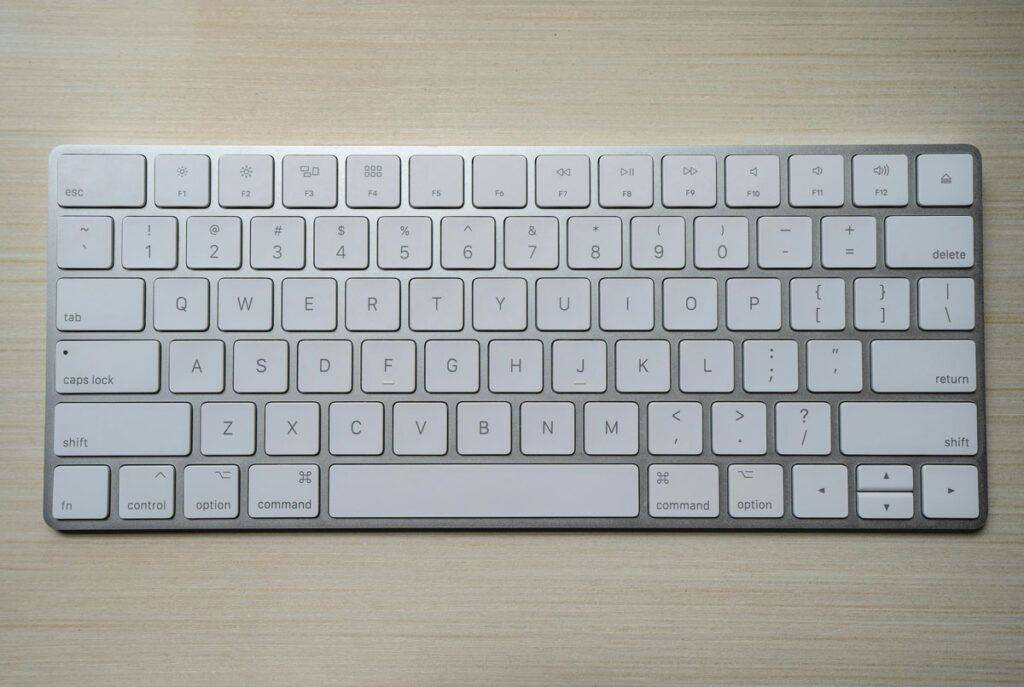
    On any keyboard, lightly touch the F and J keys to find the small keys on each key. Carefully place your fingers on them, and then place the other fingers in the same order – your left hand should be on ASDF and your right on JKL; these are the keys to the house.

    Place your finger lightly on the capital letters as you write other letters, and move them up, down, and possibly side to side. Learn to do this quickly without looking at your hands, and you’ll be able to write things down!

    When I was a kid, I had a typewriter. To hide my hands while typing, I made a cardboard box out of duct tape that I attached to the computer. Once I had this system in place, I got a notebook and started learning to type, always keeping my fingers on the main keys and using only my right hand to type letters and numbers. Thanks to these exercises, touch typing was developed; a skill that served me well in college! Being able to knock on doors helps me with my studies and everything else.

    Thanks to today’s computers, learning keyboard shortcuts has never been easier or faster – even the QWERTY keyboard may seem unfamiliar at first! There are many programs available to help, some designed as games – making learning to write easier.

    Find the software you like to use and do it. Even if the first few days are difficult, if you work hard, you can do it. Find others and work together or plan a game; the results will not disappoint – the memories will last a lifetime! You will not regret learning this.