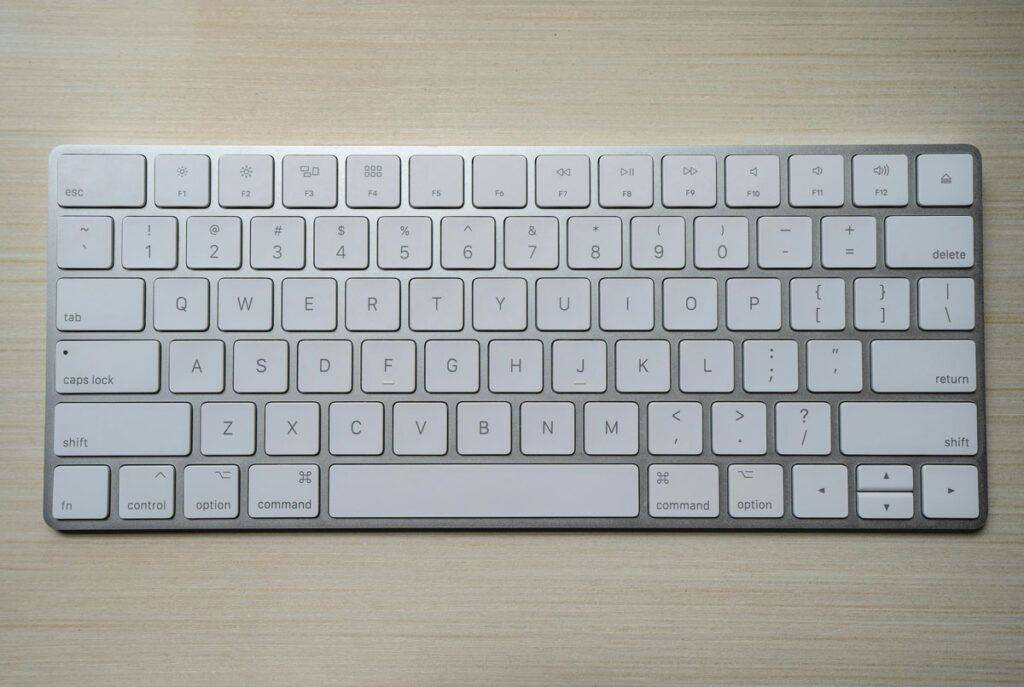
Why are the letters on my keyboard not in alphabetical order? — Baker (age 9, Arrowtown, New Zealand).
Good question! I was curious about this as a child, so as an adult I decided to study it and write about it.
Let’s go back in time: approximately 150 years ago, all letters and business documents were handwritten with a pen that was often dipped in ink; the process was slow and it was terrible.
Over the years, manufacturers have developed a variety of text editors. The first typewriters were simple pieces of metal; Their keys were the same as those of a piano and worked on the same principle.
Have you ever looked at what happens to a real piano? When you press a button, the levers of the hammer and felt pad, which touch the surface itself, cause them to vibrate.
The old typewriters were the same; they had levers with metal letters on either end, you had to press each letter hard to move the metal letter towards the paper, so when you pressed “A” your metal letter was right next to the paper where the A was written, more books were played and more words were written!
The first machine had the letters arranged alphabetically. Unfortunately, if both keys were opened too quickly, the levers could jam. Jamming usually occurred between keys near the keyboard. To prevent jamming, the jamming problem could be alleviated by rearranging the letters.
Christopher Shoals is an American Indian who is known for his sculptures. He tried to eliminate the need to type on two keys close together by experimenting with different layouts, and came up with what is now known as the QWERTY keyboard – look closely and you’ll get the name.
The Remington Company of America eventually bought his investment and began selling its QWERTY keyboard in the 1870s.
After the Remington typewriter first appeared, many people around the world learned to type on touch (which allowed them to type without looking at the keyboard) and they became widely used for business and government records using the QWERTY keyboard. Over time, as more and more people used it, it actually became more difficult to change the layout of the keyboard.
Several other valve layouts have been tried; Many say they are easier to learn or faster than QWERTY; But none of them proved to be good enough; We seem to be stuck with QWERTY, but jamming is no longer an issue.
QWERTY is designed specifically for English. Other languages use variations, such as AZERTY in French and QWERTZ/QZERTY in German/Italian. If possible, find someone who speaks one of these languages in India, Germany, Japan/Korea/China and ask them what keyboard they use to type in that language.
You Won’t Regret Being Able To Knock On The Keyboard
On any keyboard, lightly touch the F and J keys to find the small keys on each key. Carefully place your fingers on them, and then place the other fingers in the same order – your left hand should be on ASDF and your right on JKL; these are the keys to the house.
Place your finger lightly on the capital letters as you write other letters, and move them up, down, and possibly side to side. Learn to do this quickly without looking at your hands, and you’ll be able to write things down!
When I was a kid, I had a typewriter. To hide my hands while typing, I made a cardboard box out of duct tape that I attached to the computer. Once I had this system in place, I got a notebook and started learning to type, always keeping my fingers on the main keys and using only my right hand to type letters and numbers. Thanks to these exercises, touch typing was developed; a skill that served me well in college! Being able to knock on doors helps me with my studies and everything else.
Thanks to today’s computers, learning keyboard shortcuts has never been easier or faster – even the QWERTY keyboard may seem unfamiliar at first! There are many programs available to help, some designed as games – making learning to write easier.
Find the software you like to use and do it. Even if the first few days are difficult, if you work hard, you can do it. Find others and work together or plan a game; the results will not disappoint – the memories will last a lifetime! You will not regret learning this.